A Guide to Partnering with Privacy and Cybersecurity Law Practices
A Guide to Partnering with Privacy and Cybersecurity Law Practices
In an era where data is a company’s most valuable yet volatile asset, the legal landscape surrounding privacy and cybersecurity has shifted from a back-office concern to a boardroom priority. For startups and Fortune 500 companies alike, navigating the intricate web of international regulations, such as the GDPR, CCPA, and the emerging EU AI Act, requires more than just a general counsel; it requires a specialized Privacy and Cybersecurity Law Practice.
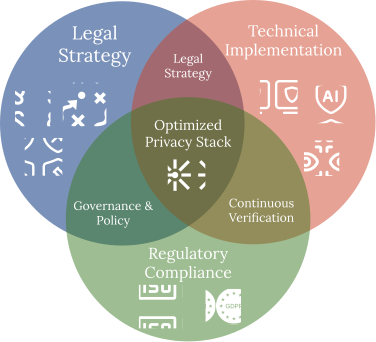
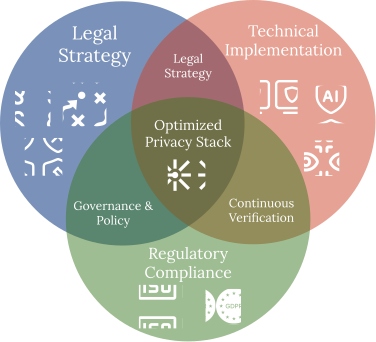
However, even the most expert legal advice can fall short if it isn’t paired with technical reality. This guide explores the essential services offered by these specialized firms and how integrating a technical automation platform like TrustedStack makes the entire compliance lifecycle more comprehensive, reliable, and cost-effective.
Certified Privacy and Cybersecurity Law Practices trained on TrustedStack Privacy and Risk tools can make the engagement and entire process clear, efficient, and cost-effective. Learn More About Our Privacy Partners
The Core Pillars of Privacy and Cybersecurity Law Practices
A specialized practice doesn’t just “check boxes”; it builds a foundation for privacy as a competitive advantage. Their core offerings typically include:
- Legal Consultation & Governance: Expert guidance on diverse regulations (HIPAA, GLBA, Colorado AI Act) and the establishment of governance structures to ensure sustained compliance.
- Policy Formation & Review: Crafting privacy policies, Data Processing Addendums (DPAs), and consent forms tailored to specific business needs.
- Rapid Response: Proactive planning for data breaches and leading the “post-mortem” activities to minimize liabilities.
- Vendor & Third-Party Management: Implementing structures to manage the risks associated with external partners and sub-processors.
- DSAR & Program Management: Creating efficient workflows for Data Subject Access Requests (DSARs) and roadmap development for privacy initiatives.
The Tedious Reality: Why Legal Advice Needs Technical Grounding
While a law firm can draft a world-class Privacy Policy, they often have huge blind spots in real-time visibility into a company’s actual digital footprint.
This visibility gap is where most legal and financial risks reside - the unknown.
8 Critical Evidence Points on Privacy and Disclosure Gaps:
- Escalating GDPR Fines: According to the DLA Piper GDPR Data Breach Survey, total fines issued by European regulators have surpassed €4 billion, often triggered by “lack of a legal basis for data processing”, frequently due to undisclosed tracking.
- The High Cost of Silence: The IBM Cost of a Data Breach Report 2023 found that the global average cost of a data breach reached $4.45 million, a 15% increase over three years. Organizations that involved law enforcement and legal experts saved nearly $470,000 per incident.
- Undisclosed Tracking Pixels: The Federal Trade Commission (FTC) has intensified enforcement against tracking pixels. In a landmark settlement, BetterHelp was fined $7.8 million for sharing sensitive health data with third parties like Facebook, despite promising privacy, a direct result of technical activities contradicting legal policies.
- The “Shadow” Sub-processor Risk: Gartner predicts that through 2025, 60% of organizations will use cybersecurity risk as a primary determinant in conducting third-party transactions. Undisclosed sub-processors represent a massive “hidden” liability in these audits.
- Materiality in Disclosures: The SEC’s 2023 Cyber Disclosure Rules now require public companies to disclose “material” cybersecurity incidents within four business days. Failure to have a technically-verified inventory of assets makes meeting this deadline nearly impossible.
- DSAR Inefficiency: A survey by Forrester Research highlighted that the manual fulfillment of a single DSAR can cost a company upwards of $1,400. Without technical discovery tools, legal teams spend hundreds of hours manually chasing data.
- AI Regulatory Risk: The EU AI Act introduces fines of up to 7% of global turnover for non-compliance. Law firms can advise on the law, but companies cannot comply without technical visibility into where AI models are actually deployed.
- Reputational ‘Trust’ Tax: The PwC 2023 Global Risk Survey found that 40% of consumers will stop buying from a company if they lose trust in its data practices. Disclosure gaps are the fastest way to erode that trust.
How TrustedStack Enhances the Legal Partnership
TrustedStack bridges the gap between the law firm’s advice and the company’s actual operations. By providing real-time visibility and automation, it transforms ‘point-in-time’ legal audits into continuous, reliable compliance.
1. Verifying Policy vs. Reality
A law firm drafts your Privacy Policy; TrustedStack verifies it. TrustedStack’s discovery engine identifies every tracker, cookie, and script running on your digital properties. If a marketing team installs a new pixel that violates the DPA drafted by your lawyers, TrustedStack flags it immediately, preventing an FTC-style enforcement action.
2. Mastering Vendor & Sub-processor Transparency
The Guide to Privacy Law Practices emphasizes “Vendor and Third Party Management”. TrustedStack automates this by mapping out your entire tech stack, including “shadow” sub-processors that your legal team might not even know exist. This ensures that your Data Processing Agreements (DPAs) are accurate and comprehensive.
3. Streamlining DSAR Management
Law firms create the “structure” for DSAR responses. TrustedStack provides the “engine.” Instead of manual data hunting, TrustedStack automates the discovery of data across your organization, making the process faster, more accurate, and significantly more cost-effective.
4. Supporting the POaaS Model
For companies utilizing Privacy Officer as a Service (POaaS), TrustedStack acts as the “virtual eyes” for the appointed officer. It provides the technical collateral and data needed for courtroom-ready documentation and boardroom-level reporting.
Suggested Next Steps
Partnering with a Privacy and Cybersecurity Law Practice is essential for defining your legal strategy and risk appetite. However, to reduce the potential cost impact of a breach due to shadow IT, undisclosed AI or other emerging attack vectors, or avoid the potential cost of a multi-million dollar risk of regulatory fines, that legal strategy must be powered by technical truth.
By integrating TrustedStack with your legal operations, you move from a reactive posture to a proactive one. You ensure that your policies are not just “paper-compliant,” but operationalized, making your legal spend more efficient and your organization significantly more resilient. And you can achieve all this while reducing friction and digital-assets chasing across teams.
Ready to modernize your legal operations? Explore TrustedStack’s Legal Solutions and bridge the gap between legal counsel and technical reality.